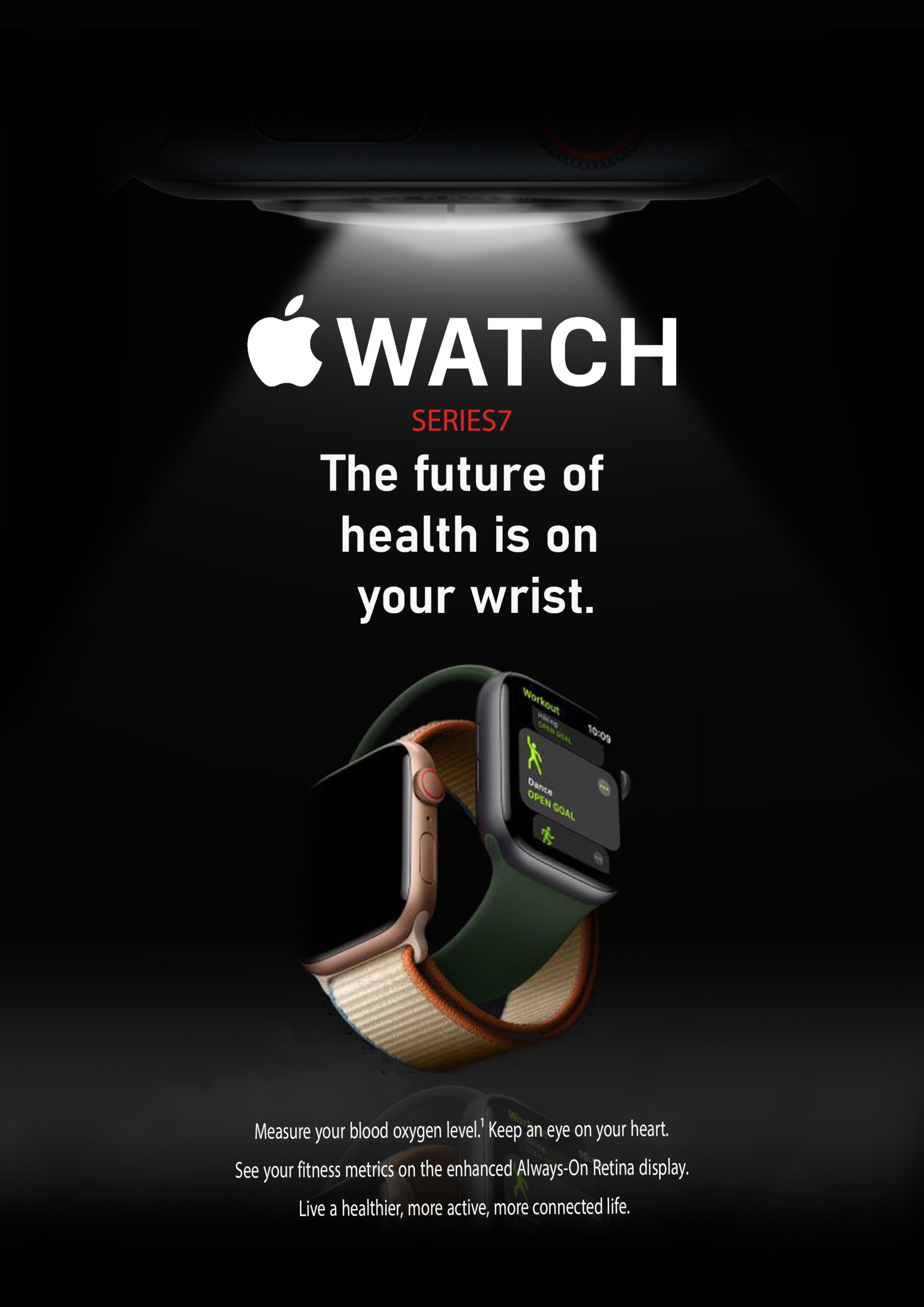
Since 2015, the Apple Watch has been positioned at the intersection of luxury branding, digital networking, and health culture. The tagline of the Series 7: “The Future of Health is on Your Wrist” (fig. 1). Its form combines the classic wristwatch—itself a symbol of discipline and precision in the industrial age—and the touch-screen interface of the smartphone. The Apple Watch, says Tara Brabazon, is a wearable computer that “offers simple and everyday interfaces to connect an analogue body to digital environments” (15). It promises a new kind of self-knowledge: Users monitor their heart rates, oxygen levels, sleep patterns, and productivity metrics in real time. These features link the user’s body to the cloud through continuous connectivity. The watch as a device has always been about control over time, a preoccupation that was central to industrial capitalism’s synchronization of labor. Consumers benefitted from the wristwatch, but the true beneficiaries of the technology were industrialists who could precisely coordinate worker schedules to maximize efficiency. The Apple Watch extends this logic into the body itself. In an article for Current Affairs, Ben Lee describes the creation of this niche: Such technologies create demand by suggesting that “the unoptimized life is not worth living.” Where the Model T organized workers around the assembly line, the Apple Watch organizes attention around an algorithmic schedule of notifications. Time discipline is thus internalized: The user is no longer merely on time but inside time, monitored by a wearable device that quantifies the rhythms of everyday life and syncs them with the rhythms of industry. “Just as capitalism promises the domination of nature,” says Lee, “surveillance capitalism promises the domination of human nature via our behavior.” Mahoney might see this trend as an extension of the historical logic he identified in Ford’s machine—the integration of human action into machine logic—only now rendered continuous, intimate, vaguely judgemental, seamlessly harmonized with the cadences of our personal habits.
Like the Model T, the material design of the Apple Watch expresses a veiled ideology. Its aesthetics and materials—smooth aluminum, rounded edges, quiet haptics—both conceal and reflect the industrial processes that spawned it: Coordinated global supply chains, the violence of rare-earth extraction, precision robotics and factories that treat human laborers like robots. Like many contemporary technologies, the device hides the messy, exploitative processes that go into its construction beneath a surface purity. The clean minimalism of its surface speaks the design language of streamlining: Nothing unnecessary, no evidence of its construction. Mahoney’s interpretive praxis would insist we attend to this surface as signification—the invisibility of labor becomes part of the machine’s message. The watch is seemingly sprung whole-cloth from the mind of geniuses, not the result of vast, oppressive networks of globalized neo-colonialism. Functionally, it converts the user’s body into a data interface. Heartbeat sensors, gyroscopes, accelerometers translate motion and pulse into metrics—steps taken, calories burned, hours stood. These are not just mechanical operations but acts of writing: A phantom outline of the body reinscribed in machine language. The watch “reads” the wearer as an assemblage of data points, producing what Jean Baudrillard might define as a quantifiable, optimizable, and monetized self, a human form “produced from a radiating synthesis of combinatory models in a hyperspace without atmosphere” (Baudrillard 2). In Lee’s more prosaic words: “to call this utility ‘convenience’ is to outright deny our autonomy and consent. The age-old tradeoff between privacy and convenience thus breaks down completely.” These data are also, significantly, a product. According to Zuboff,
Although some of these data are applied to product or service improvement, the rest are declared as a proprietary behavioral surplus, fed into advanced manufacturing processes known as ‘machine intelligence,’ and fabricated into prediction products that anticipate what you will do now, soon, and later.” (Zuboff 14)
Products like the Apple Watch create an inhuman mirror-world populated by human ghosts. Tirelessly, it translates our behavioral data (or maybe our souls) into commodities that profit corporate entities.
Symbolically, the Apple Watch de- and reconstructs time. The classic watch measured and universalized external time, dividing the day and regulating each division’s sanctioned activities, as Michel Foucault teaches in Discipline and Punish. At the height of the time-table, its “three great methods—establish rhythms, impose particular occupations, regulate the cycles of repetition—were soon to be found in schools, workshops, and hospitals” (Foucault, Discipline 149). The digital watch intensifies this process by measuring personalized time—quantifying our micro-temporalities of sleep, exercise, productivity. Its “stand up” alerts and “breathe” reminders construct an economy of health with distinctly moral overtones: To be sedentary is to fail; to obey is to seek redemption. This disciplinary function urges us to manage our lives through self-surveillance: It is the very apotheosis of panopticism. “In the correct use of the body, which makes possible a correct use of time,” says Foucault, “nothing must remain idle or useless: Everything must be called upon to form the support of the act required” (Discipline 152). Mahoney’s framework makes clear that such moral coding is not accidental: it is written into the machine’s code and its surface, a grammar of virtue expressed in imperatives, optimized metrics, the completion of color-coded rings. At the same time, the Apple Watch has another symbolic function. It is expensive and glossy, an object that communicates status and sophistication. It embodies technological refinement and participation in the Apple brand’s mythos of innovation, of sleek-and-streamlined good taste. This symbolism mirrors Mahoney’s reading of the Model T as both tool and cultural sign—an object that does a job and an object through which individuals enact belonging within the socio-economic order. The Apple Watch’s design encodes not only data but identity: To wear it is to inhabit a certain ideology of progress, refinement, prestige.
To read an Apple Watch is to interpret not only its function but also the layered systems of thought, labor, and ideology that its design encodes. It offers a moral rhetoric of frictionless efficiency—an ideology of seamlessness that hides the immense complexity beneath. Artifacts embody the logic of the systems that produce them. The Apple Watch’s seamless interface masks a deeply fractured production chain that spans Congolese cobalt mines, Chinese assembly lines, Silicon Valley design labs, and global data centers. Hidden, too, is what the device assumes. The Apple Watch assumes a world of constant network access, GPS coordination, and instantaneous feedback. Though its marketing claims human flourishing as its goal, acclimatizing citizens to ever more efficient habits and schedules seems closer to its actual ends. Its default temporal logic is one of acceleration, demanding continual attention and response. It must be tended and fretted over, which trains the body into rhythms of digital labor and micro-work. Each time we tap its face is a minute gesture within a vast choreography of data extraction. Where Ford’s machine embodied the logic of industrial efficiency, Apple’s embodies the logic of algorithmic proficiency. Both naturalize their systems of production by translating them into desirable forms. In the end, the Apple Watch tells a story about the convergence of time, capital, and the fully instrumentalized body. It makes visible—and wearable—the contemporary belief that technology can harmonize life through metrics, at the same time that it strips data from its users for profit. By reading the watch as a text, we glimpse the contradictions it conceals: A seamlessness that depends on invisible labor; a false autonomy built on surveillance; and a health ideology that commodifies human thriving.
Works Cited
Baudrillard, Jean. “The Precession of Simulacra.” Simulacra and Simulation, translated by Sheila Faria Glaser. U. of Michigan P., 1994, pp. 1–42.
Brabazon, Tara. “Digital fitness: Self-Monitored Fitness and the Commodification of Movement.” Communication, Politics & Culture, vol. 48, issue 2, 2015 pp., 1-23.
Foucault, Michel. Discipline and Punish. Translated by Alan Sheridan, Vintage Books, Random House, 1995. Kindle Edition.
—. The History of Sexuality, Vol. 1. Translated by Robert Hurley, Vintage Books, Random House, 1990. Kindle Edition.
Lee, Ben. “Putting the ‘Capitalism’ in ‘Surveillance Capitalism.’” Current Affairs: A Magazine of Technology and Culture, 15 May 2021.
Mahoney, Michael S. “Reading a Machine.” Class Handout, CMPM 201, Nathan Altice, Fall 2025, c. 1980, pp. 1-8.
Thoreau, Henry David. Walden. T. Y. Crowell & Company, 1899, Internet Archive, Accessed 2 Nov 2025, p. 53.
“Tick-Tock to Success.” Apple Watch Advertisement, The Higher Institute of Applied Arts, Clios Ads of the World, 2021. Accessed Nov. 1, 2025.
Zuboff, Shoshana. The Age of Surveillance Capitalism: The Fight for a Human Future at the New Frontier of Power. Hatchet Book Group, 2019.